CEPAMS Research Unravels Key Mechanism Governing Plant Stem Cell Activity
In a study published today in Science, researchers from the CAS–JIC Centre of Excellence for Plant and Microbial Sciences (CEPAMS) have revealed a novel mechanism that controls plant stem cell dynamics through precise spatial patterning of cell wall modification. The work was led by Dr. Weibing Yang, a group leader at the Chinese Academy of Sciences, with key contributions from Prof. Yiliang Ding of the John Innes Centre (JIC) in the UK.
Plant cells are enclosed by a dynamic and structurally complex wall that provides mechanical support and determines cell shape. A major component of cell wall is pectin, a gel-like substance whose chemical modification—specifically, methylesterification—acts as a critical switch controlling wall stiffness and flexibility. However, how plants spatially regulate this process to maintain stem cell homeostasis and ensure proper organ patterning has remained unclear.
Plant cells are enclosed by a dynamic and structurally complex wall that provides mechanical support and determines cell shape. A major component of cell wall is pectin, a gel-like substance whose chemical modification—specifically, methylesterification—acts as a critical switch controlling wall stiffness and flexibility. However, how plants spatially regulate this process to maintain stem cell homeostasis and ensure proper organ patterning has remained unclear.
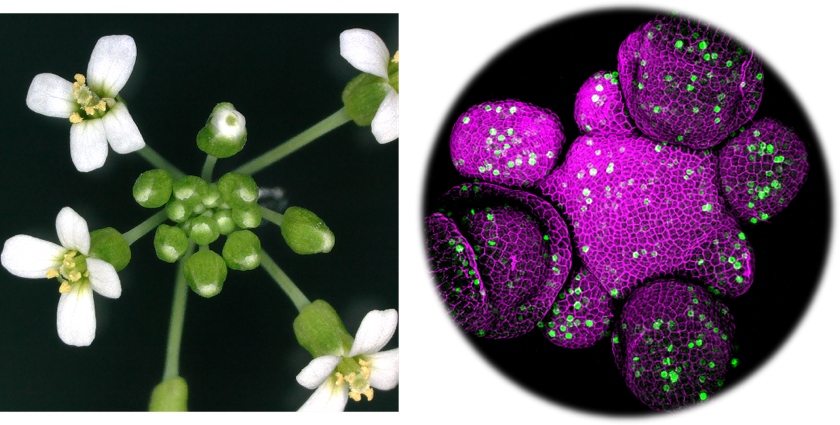
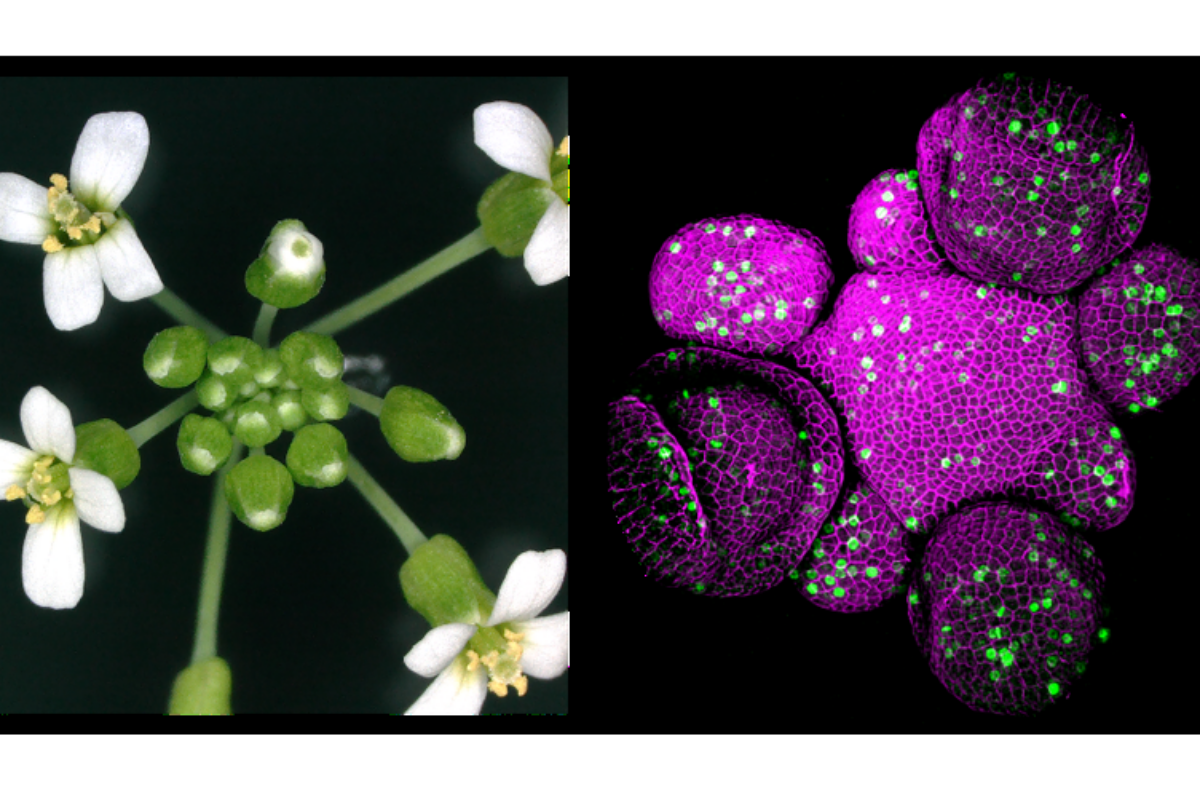
Left: the shoot apex of an Arabidopsis thaliana plant.
Right: the shoot apical meristem. Actively dividing stem cells are shown in green, and the cell walls are labelled in magenta.
The research team discovered a striking bimodal pattern of pectin methylesterification within the stem cells of the shoot apical meristem (SAM). While mature cell walls are highly methylesterified, newly formed cross walls during cell division are specifically enriched in demethylesterified pectin. This spatial heterogeneity proves essential for correct cell division orientation and stem cell maintenance.
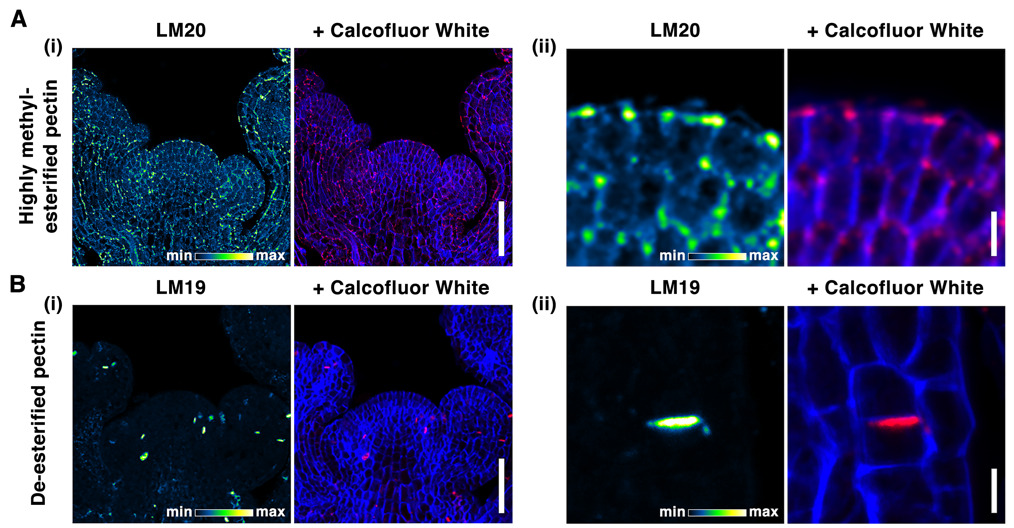
Distinct pectin methylesterification patterns in new and mature cell walls.
The study identified the enzyme PECTIN METHYLESTERASE5 (PME5) as the key driver of this localized pectin modification. Intriguingly, PME5 messenger RNA (mRNA) is strictly retained within the nucleus, prevented from being translated into protein—a process mediated by two RNA-binding proteins, RZ-1B and RZ-1C. Only upon nuclear envelope breakdown (NEBD) during cell division is the stored PME5 mRNA released into the cytoplasm. Its translation thereby becomes perfectly synchronized with cell plate formation, ensuring pectin demethylesterification occurs precisely where and when needed: at the new division plane.
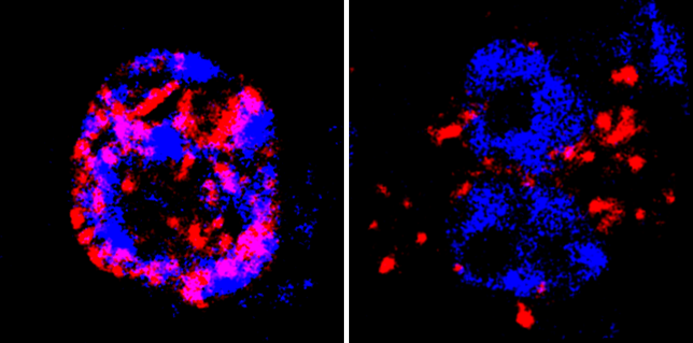
PME5 mRNAs (red) are sequestered in the nucleus (blue), which are released when the new cell walls are being formed during cell division.
“This is a beautiful example of spatiotemporal control,” explained Dr. Weibing Yang. “The cell stores mRNA in the nucleus and times its release with mitosis. This allows mature walls to remain highly methylesterified, preserving stem cell identity, while newly formed walls are locally modified to guide proper division patterning.”
The research highlights the collaborative spirit of CEPAMS, a partnership between the Chinese Academy of Sciences (CAS) and the John Innes Centre (JIC). Prof. Yiliang Ding’s expertise in RNA structure and localization was instrumental in deciphering this unconventional regulatory mechanism.
The research highlights the collaborative spirit of CEPAMS, a partnership between the Chinese Academy of Sciences (CAS) and the John Innes Centre (JIC). Prof. Yiliang Ding’s expertise in RNA structure and localization was instrumental in deciphering this unconventional regulatory mechanism.
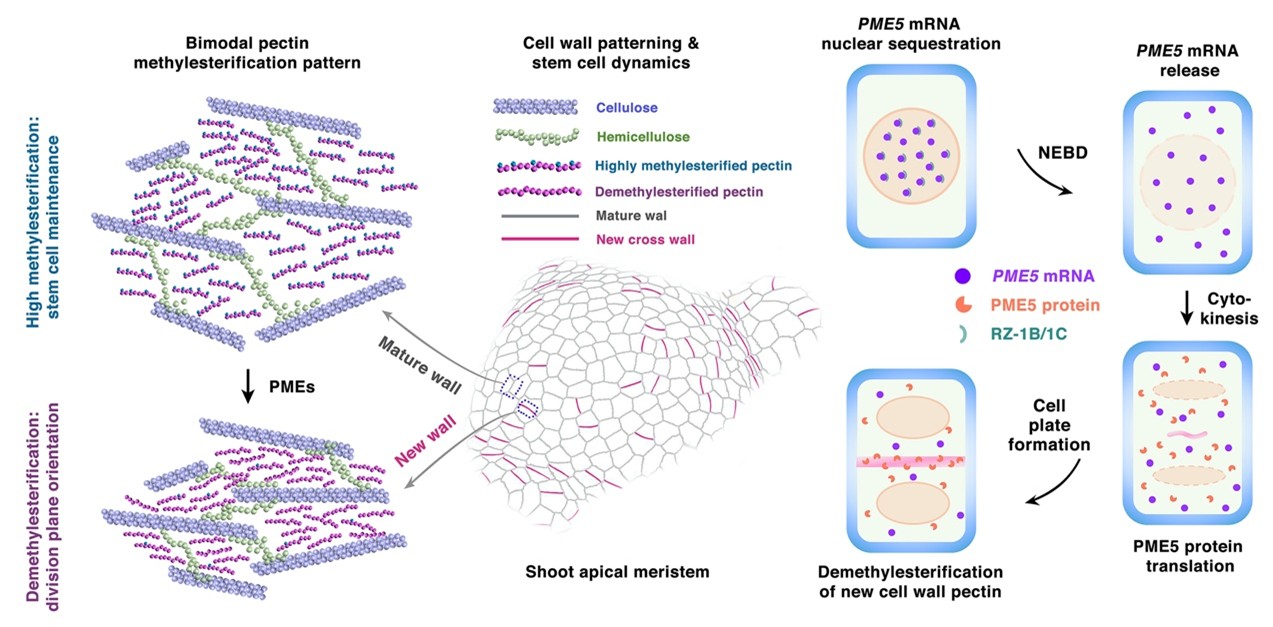
Control of plant stem cell dynamics by precise pectin modification.
“This work elegantly shows how integrating diverse perspectives can solve complex biological puzzles,” said Prof. Ding. “By combining strengths across institutions, we unraveled a fundamental process with broad implications for understanding plant development.” When this precise control is disrupted—either by blocking pectin demethylesterification or triggering premature enzyme activity—the consequences are severe: cell division patterns become disorganized, stem cell activity is compromised, and plants exhibit stunted growth.
The findings reveal an evolutionarily conserved principle observed across species such as soybean, tomato, and maize. Understanding how plants regulate stem cell dynamics through cell wall mechanics opens new avenues for engineering plant architecture, with potential applications in improving crop resilience and yield.
The paper, “Cell wall patterning regulates plant stem cell dynamics,” appears in the December 4, 2025, issue of Science.
The findings reveal an evolutionarily conserved principle observed across species such as soybean, tomato, and maize. Understanding how plants regulate stem cell dynamics through cell wall mechanics opens new avenues for engineering plant architecture, with potential applications in improving crop resilience and yield.
The paper, “Cell wall patterning regulates plant stem cell dynamics,” appears in the December 4, 2025, issue of Science.
About CEPAMS
The CAS–JIC Centre of Excellence for Plant and Microbial Sciences (CEPAMS) is a joint research center established by the Chinese Academy of Sciences and the John Innes Centre (UK). It aims to build world-leading research teams that combine complementary expertise to address major challenges in sustainable agriculture and global food security.